Archive for the ‘ American Character ’ Category

The Real 99%

Cartoonist Michael Ramirez has been highlighting some really stark comparisons in his political cartoons lately. The other day I shared his view on modern society’s upside down perception of heroes and villains. He’s back today with another poignant contrast:

I’m kind of fed up with this “we’re the 99%” baloney, which casts millionaires and billionaires as the other 1% who are ruining the world. In actuality, anyone making just above $300,000 per year is part of that 1%, which means that it’s not made up primarily of the super rich. To me, $300,000 is super rich, but compared to the Warren Buffetts and Bill Gateses of the world, it’s just a very good salary. What’s really going on with the Occupy Wall Street movement is simple Marxism, dressed up in different clothes. The goal is to overturn American society as it exists today.

Well, there are things I would like to see overturned, but not capitalism or the significance of private property. Property and liberty go hand in hand. Our Founders knew they were inseparable. If individuals don’t own property, who will? Answer: the government.

It’s time to see these occupiers for what they are and respond accordingly. Breaking up the unsanitary tent city in New York was a good start. What will that achieve? Fewer murders, rapes, thefts, and harassment of honest business people. I don’t normally think much of NYC’s mayor Bloomberg, but in this case, he finally did what was necessary.

I’ll stand with those who believe in Christian foundations, fiscal responsibility, and constitutional government. They are the hope for the future.

The Anthony Verdict

I had something else I wanted to write about today, but the verdict in the Casey Anthony trial yesterday is overshadowing all other events. Fine. I have a few things to say about that.

I was watching as the verdicts on the various counts were read: not guilty of murder, not guilty of manslaughter, not guilty of child neglect/abuse, guilty on all counts of lying. My first reaction? What a travesty. Now that I’ve had time to ponder the verdicts some more, and can back away from my initial emotional response, I have concluded the following: it’s a travesty.

I can see why the jury might not have come in with a guilty verdict on outright murder—there are some questions that remain unanswered about how little Caylee Anthony died. Yet the mountain of circumstantial evidence that Casey was somehow involved, or at the very least didn’t care about her daughter’s wellbeing, is overwhelming. How could she not be found guilty of child neglect? She didn’t report Caylee was missing for a month. During that time, she was out partying. She even got a tattoo that said, in Italian, “Beautiful Life.” The prosecution’s claim that she wanted to be rid of her daughter, who was keeping her from “enjoying” her life, rings true.

And why all the lying, for which she was convicted? Why would she go to such outlandish lengths as to fabricate the existence of a nanny/housekeeper? Her entire story was one long string of lies, easily demolished by investigators. The only reason I can figure why she built this house of cards was to cover up for the death of her daughter. And why cover it up if it had only been an accident? Why, when Caylee’s body was found, was there duct tape over her face? Why did Casey’s car have the stench of a decomposing body?

How in the world could a jury come back with “not guilty” on all the most significant counts? If they truly believe she lied so profusely, there had to be something significant to lie about. To conclude that she lied on all matters relating to the death, and not to connect those lies to culpability regarding the death itself is really rather incomprehensible.

I’m not the kind of person who calls for vigilante justice when an injustice occurs in the system. I believe in the rule of law, as I’ve stated so many times in this blog. I know a jury has to take into account “reasonable doubt,” but in this case, please forgive me if I think the jury misunderstands that term. Just because some shred of doubt may exist, that’s not the same as reasonable doubt. Circumstantial evidence is sufficient if there is enough of it; to most people following the trial, the circumstantial evidence was convincing.

If Casey Anthony is innocent, so is O.J. Simpson.

This is another miscarriage of justice. What rubs salt into this societal wound is the defense team itself, another in a long list of criminal defense teams that give a bad name to the profession. The lead man, Jose Baez, used the verdict to rail against the death penalty. It seems he has an agenda. Another of the team lashed out against lawyers who commented on the case on television. Overall, they indicated that Casey’s character was maligned unfairly. It seems to me that her character is quite clear, and anything negative said about her can be backed up by her lifestyle. And what did this defense team offer as an alternative explanation for Caylee’s death? Pure speculation. Drowned in a pool. Where was the evidence for that? Fortunately for them, the entire Anthony family seemed to be dysfunctional enough to make a jury believe anything was possible.

What is she going to do now? Get a “reality” television show? Write a bestselling book? Don’t be surprised. We are a culture that thrives on this type of “entertainment.” Perhaps that jury is simply a reflection of who we are collectively.

Scary.

Reflections on American Morality

The whole Anthony Weiner incident has left me deeply disturbed about the tenor of our society. That’s nothing new, of course, since I believe man in sinful and plays out that sinfulness continually. Yet this particular episode I find particularly perturbing. Let me see if I can explain why.

Weiner himself is what I always expected him to be; I’m less concerned about him personally than I am about other aspects of this. The media, both liberal and conservative, seem to be painting the women involved as victims of a sexual predator. There’s no disputing Weiner is a sexual predator, but if these women were victims, they were more than willing to be victimized.

One of them, Megan Broussard, has conducted interviews over the past two days, one on ABC, the other on Sean Hannity’s Fox program. I watched the latter. First of all, I was not impressed with her grasp of basic morality. She thought it would be “fun,” I guess, to banter sexually with a married congressman. Only when she feared her tweets would become public, or the pictures she sent him would be displayed on the Internet did she decide to preempt that exposure by speaking up. Even now, she doesn’t seem to have any real concept of having done anything inappropriate—at least on her part. And when asked if Weiner should remain a congressman, she had no opinion, saying that it was up to the voters in his district.

She is a microcosm of the state of morality in America at this time, I fear. She obviously doesn’t represent the morality of all, but I do wonder if she is representative of the majority: morally clueless.

Even now, only a slim plurality of Weiner’s constituents think he should step down. He may be able to ride this out. His arrogance is that great.

I think back on the Clinton impeachment. Even though it was evident that he had abused the trust given him by the electorate, and that he had committed perjury, public opinion polls indicated that about 2/3 of the country didn’t want him removed from office. I recall being dispirited over that at the time.

Just who are we as a people?

I want to believe better about us, but I don’t know if I can. After all, we put Barack Obama into the highest office in the land.

There is no golden age in our history where everyone was Christian and all was well, but there certainly was a time when we, as a society, had a keener understanding of eternal right and wrong, and when we veered off course, we at least felt guilty.

Does genuine guilt exist as a force in America anymore? Only by comprehending guilt will we ever seek forgiveness and reconciliation with God. I hold the firm conviction that nothing less than an explicitly Christian moral standard, and a firm belief in the transforming power of a Spirit-filled existence, will suffice to hold our society together. Without that basis, we will spin out of control.

I’m reminded of a quote from Christian statesman Robert Winthrop, who, in a speech to the Massachusetts Bible Society in 1849, pointed out a significant truth:

All societies of men must be governed in some way or other. The less they may have of stringent State Government, the more they have of individual self-government. The less they rely on public law or physical force, the more they rely on private moral restraint. Men, in a word, must necessarily be controlled, either by a power within them, or by a power without them; either by the Word of God, or by the strong arm of man; either by the Bible or the bayonet.

Here’s the rub: do we still have enough people who live by individual self-government to make the difference, or are we in the process of losing all moral restraint? The reason I write and teach is that I believe there is still hope. I hope I’m right.

Chambers: Death of a Nation?

Those who have read this blog long enough know my affinity for Whittaker Chambers, a man I consider one of the true heroes in American history. He had joined the Communist Party in the 1920s, thinking it was the answer to all the world’s crises. Only later did he come to grips with his error, but when he did, a whole new understanding opened to him.

As he notes in his masterful autobiography Witness, his mind had to be renewed completely:

What I had been fell from me like dirty rags. The rags that fell from me were not only Communism. What fell was the whole web of the materialist modern mind—the luminous shroud which it has spun about the spirit of man, paralyzing in the name of rationalism the instinct of his soul for God, denying in the name of knowledge the reality of the soul and its birthright in that mystery on which mere knowledge falters and shatters at every step.

As he stepped out into his new reality, he found faith in God, and that gave him insight that is well worth sharing with our generation:

External freedom is only an aspect of interior freedom. Political freedom, as the Western world has known it, is only a political reading of the Bible. Religion and freedom are indivisible. Without freedom the soul dies. Without the soul there is no justification for freedom. … Hence every sincere break with Communism is a religious experience.

There has never been a society or a nation without God. But history is cluttered with the wreckage of nations that became indifferent to God, and died.

That last line is haunting. How indifferent are we as a nation right now? How close are we to death?

Tocqueville & American Christianity

Alexis de Tocqueville, a Frenchman who toured America from 1831-1833, was a keen observer of what he experienced. He put those observations into a famous book, still used in political sciences courses, called Democracy in America, first published in 1835.

Tocqueville quotes can be found throughout the Internet; unfortunately, some of them dealing with religion in America are more legend than fact. I know, since I’ve read the entirety of his book without finding them. However, he did make clear statements about the influence of the Christian faith on American society. Here are some samples:

There is an innumerable multitude of sects [denominations] in the United States. All differ in the worship one must render to the Creator, but all agree on the duties of men toward one another. … All the sects … are within the great Christian unity, and the morality of Christianity is everywhere the same. …

… America is … still the place in the world where the Christian religion has most preserved genuine powers over souls; and nothing shows better how useful and natural to man it is in our day, since the country in which it exercises the greatest empire is at the same time the most enlightened and most free.

So this French observer was duly impressed with the unity he discovered among the various Christian denominations and the pervasiveness of the Christian faith in the nation. He also saw another practical effect of the universality of Christian faith: “Of the world’s countries, America is surely the one where the bond of marriage is most respected and where they have conceived the highest and most just idea of conjugal happiness.” Would that were the case today.

Christian influence on the morals of society dominated, according to Tocqueville:

Revolutionaries in America are obliged to profess openly a certain respect for the morality and equity of Christianity, which does not permit them to violate its laws easily when they are opposed to the execution of their [revolutionaries'] designs; and if they could raise themselves above their own scruples, they would still feel they were stopped by those of their partisans. Up to now, no one has been encountered in the United States who dared to advance the maxim that everything is permitted in the interest of society. An impious maxim—one that seems to have been invented in a century of freedom to legitimate all the tyrants to come.

So, therefore, at the same time that the law permits the American people to do everything, religion prevents them from conceiving everything and forbids them to dare everything.

Religion, which, among Americans, never mixes directly in the government of society, should therefore be considered as the first of their political institutions; for if it does not give them the taste for freedom, it singularly facilitates their use of it.

Tocqueville’s experience in France had taught him that religion combines with the state to produce tyranny. He was amazed to find the opposite in America:

On my arrival in the United States it was the religious aspect of the country that first struck my eye. As I prolonged my stay, I perceived the great political consequences that flowed from these new facts.

Among us [in France], I had seen the spirit of religion and the spirit of freedom almost always move in contrary directions. Here I found them united intimately with one another: they reigned together on the same soil.

What we have here is a nineteenth-century Frenchman with a sharper vision of the greatness and uniqueness of America than most current commentators, particularly those on the Left of the political spectrum. If only they would listen and learn from him.


The Only Real Hope

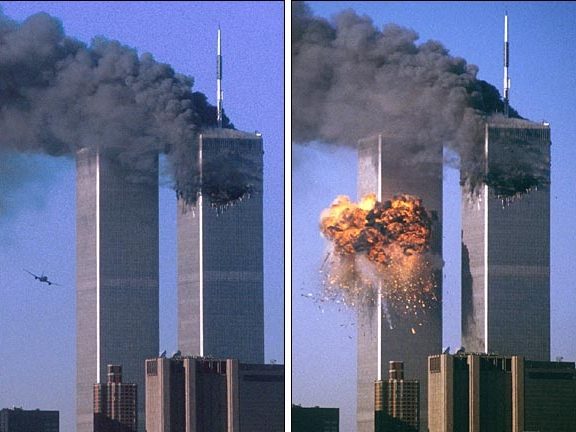
I was surprised, but gratified, by the commemorations of 9/11 that took place on Saturday. They were dignified, and lacking antagonism despite the ongoing attempt to place a mosque near the Ground Zero site.

For me, the ceremonies were an indication that our collective memory has not yet been erased. There are some things that a nation should never forget. The real question, though, is whether we will learn the right lessons from such events.

Unfortunately, there will be some who will believe what this fictional professor has declared. If only all such people were truly fictional.

The Christian response is twofold: first, keep up a guard against the real enemies who do exist—Islamic extremists—and root them out; second, continue to reach out to those trapped in a worldview that leads to hatred. The Christian message of recognition of sin and the offer of forgiveness through the atonement of Jesus remains the only hope for genuine reconciliation.

Today’s Surprise: I Recommend My Own Books

In the nearly two years that I’ve written this daily blog, I’ve never, to the best of my recollection (how’s that for a lawyerly term that gets me off the hook if I’m wrong?), advertised for books I’ve authored. Today, though, I would beg your indulgence, since I’ve just had a new edition of one of my books come off the presses.

I first wrote If the Foundations Are Destroyed in 1994. This is now the fourth edition of it, complete with a new cover. Why might you want it? The subtitle, Biblical Principles and Civil Government, tells you what it’s all about. I go through what I consider to be Biblical principles and how they apply to government. These form the basis of all my analyses of current government policies. So if you are a regular reader of this blog, this book will provide a window into why I believe as I do.

I have excerpted some of these concepts on the blog already as an overview. If you are interested in a preview, just click on the “Biblical Principles” category in the right sidebar. To learn more about the book and to order it, go to:

http://ponderingprinciples.com/books/itfad/.

While I’m at it, let me talk briefly about the other two books I’ve written.

I did my doctoral dissertation on Noah Webster. While writing it, I had in mind that I wanted to make it into a publishable book. That’s not always easy with a doctoral dissertation, but I made every effort to ensure the writing style was accessible to a general audience as well as scholars. I hope I succeeded.

Webster was the schoolmaster to early America. His speller and dictionary could be found in nearly all American homes. The subtitle, A Spiritual Biography, lets you know that my goal in this book was to chart the course of Webster’s thinking and worldview. At age 50, he experienced a conversion to orthodox Christian faith. How did that affect his scholarly work? The book compares the pre-conversion Webster with the post-conversion man, while offering along the way an accounting of his contributions to American life and culture. To find out more and order this book go to:

http://ponderingprinciples.com/books/webster/.

In 2001, I completed a study of the Clinton impeachment. My approach was different than any of the other books on the impeachment written at that time. I wrote it from the perspective of the thirteen congressmen—they were called House Managers—who went to the Senate to argue for Clinton’s removal from office. I personally interviewed all thirteen of the Managers in their Capitol Hill offices; this book provides their story on why they thought it was essential to go forward with these impeachment proceedings in spite of public opposition. It’s a study in character and the significance of the rule of law in society.

At the time of its publication, it was a main selection for the Conservative Book Club. Well-known author and editor of World magazine, Marvin Olasky, wrote the foreword for me. This is the only one of my books that is currently out of print (which I hope can be changed someday), but it is still available for those who are interested. For one of the limited number of new copies that still exist, you can order from this page:

http://ponderingprinciples.com/books/misimp/.

If you don’t mind getting a used copy, check out Amazon.

I don’t offer these with any expectation of becoming fabulously wealthy. My primary concern is to disseminate valuable information. I’ve promoted books by a number of authors over the past two years. I just wanted to make sure you are aware of mine as well. I hope some of you decide to add one or more of these to your library.