
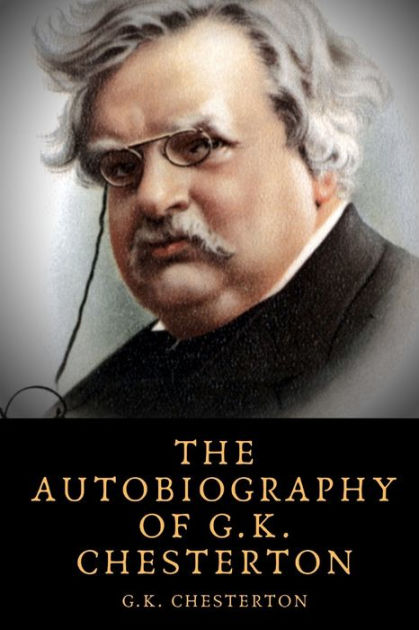
G.K. Chesterton begins his autobiography in his most Chestertonian manner, stating, “Bowing down to blind credulity, as is my custom, before mere authority and the tradition of the elders, superstitiously swallowing a story I could not test at the time by experiment of private judgment, I am firmly of the opinion that I was born on the 20th of May, 1874, on Campden Hill, Kensington.”
Can anyone top that when attempting to write an account of one’s life? I won’t even try. But I can follow in Chesterton’s wake by saying that bowing down to the authority of my parents who were there at the time, I am firmly of the opinion that I was born on the 27th of March 1951, in the small Indiana town of Bremen.
Chesterton was writing an autobiography. I’m not. That’s much too difficult. There are so many details in a lifetime, many far too mundane to generate sufficient interest. I’ve begun—tentatively, with some trepidation—a memoir. At age 75, perhaps I’ve now had enough experience in life to help others as they move ahead in their lives.
A memoir is somewhat different than an autobiography. What would be the difference? Well, as a well-trained academic, I decided to look up a definition. What I discovered is that even though a memoir might be classed as a type of autobiography, it doesn’t have to be the story of an entire life. One can be more selective and simply focus on those thoughts, incidents, career moves, mistakes, and sometimes disastrous decisions that make life more than a chronological listing of events. Mine would have to center on what God has done in my life: the various twists and turns as I developed from an immature young believer into an immature older believer. Well, that may not be fair; it doesn’t give God the credit He deserves.
Sadly, though, maturity isn’t automatic with age.
This leads to the big question. Why would anyone be interested in reading about my life? I’m not famous nor essential to any discernible earthshaking accomplishments. I do have a few thousand students who have passed through my university classes. Some of them would be interested in how my life has proceeded once they were freed from my tutelage. There are also professorial colleagues who might want to figure out why I am what I am and what has made me into whatever I am currently. And there are those among a special niche of readers who, like me, are fascinated with C.S. Lewis and several other British authors—Chesterton, J.R.R. Tolkien, George MacDonald, and Dorothy Sayers, in particular. If they are familiar with the two Lewis books I’ve authored, they may find this one worth checking out.
There’s the rub, though. All my writing to date has been rather academic. The problem with a lot of academic writing is that it is woefully unintelligible to a general audience. I’ve tried to keep that in mind when assembling my thoughts in those books and have attempted to avoid words that make people scratch their heads and/or resort to online definitions so that they will be willing to continue their reading “adventure.” I’ve never wanted my reading audience to be strictly an academic one. “Boring” has never been the goal.

Then there’s the issue of self-centeredness. Who writes memoirs? Are such works merely a way to puff oneself up? What does the Lord think of that? Is it at all possible that one can write a memoir, not from selfishness, but from a genuine desire to put something in the public realm that could actually be helpful: a vehicle for pointing people to a deeper knowledge and closer relationship with the One who sacrificed all for them?
Another possible problem is that one can fall into self-deception about the motive for writing. Motive is key. One doesn’t write a memoir for self-congratulation. Even pointing out disgraceful actions in the past and being open about mistakes and sins can be, despite the apparent transparency, an attempt to receive praise for being so “honest.”
Checking one’s motives involves another potential pitfall: an introspective mindset that can tie oneself in knots. Am I doing that already? I hope not. Anyone wanting to write a memoir must consider the myriad problems that could arise. The bottom line here is whether I have asked God if I should do this. If I sense that He gives the “okay” to the project, I must be quite sure what He wants it to achieve.
Even though this memoir is about my life, that doesn’t mean it will be centered on me exclusively. There should be a list of characters with whom I’ve interacted through all these years and how their influence impacted others besides me. There are the members of my family, of course, friends I’ve known, Sunday School teachers whose love for the Lord was obvious, mentors in high school and throughout my quest for academic excellence. There are colleagues where I’ve taught, and remembered moments, whether sad, joyous, or inspiring. What about the great theological questions and the study of history and government throughout my career? Peak times as a professor, and not-so-peak times, have also been part of my world. What have I learned from them? Did I learn what I should have learned?
Realization: this needs to be theme oriented. I will begin with foundations for my life, which means that my spiritual journey, which is the cornerstone for everything that follows, is a priority. It’s not a smooth journey. Chasms must be bridged, crooked paths require straightening, and often painful character development calls for perseverance. Yet, throughout the journey, Someone is with us even when we can’t sense His presence. My conscious spiritual journey began in childhood, rocketed to a spiritual height early, suffered a jolt shortly afterward, and though for some years I wandered through a self-created wasteland, I eventually found my way back home. But not without consequences that still surface at times even now. One thing I know for sure: God is merciful. After coming back “home,” I found myself referring to Him as “The God of the Second Chance.” I usually add, “And I don’t ever want to be in a place to find out if He will be ‘The God of the Third Chance.’”

What should come next? Perhaps some of the most memorable parts of my growing up years prior to embarking on a world that wasn’t anticipating me. My college years, which includes a marriage that has now passed its golden anniversary, is a logical next step, followed by a first career in Christian television and radio. A stint as headmaster of a Christian school was instrumental to the decision to pursue a doctorate in history. That took nearly a decade to achieve, but that’s when God brought me out of the self-created wasteland mentioned above and taught me some valuable lessons.
My academic career must take up a major portion of this memoir since it has encompassed more than three decades of my life. I began as an adjunct professor at a state university before teaching at four different Christian universities. I’m grateful for all the opportunities the Lord has given me.

I debated whether to include a shift in my response to the political climate in the nation but concluded that I can’t omit it. It’s not that my bedrock principles have changed, but that so much else has changed that I have had to rethink political connections. It would be nice to leave out that specific controversial part, yet it’s so intertwined with what the Lord continues to teach me that I don’t see how I can honestly avoid it.
Readers should come away with a deeper appreciation for God’s love and mercy, for His constant attention to our needs and capabilities, and for the fact that He is faithful to us even when we have been found faithless to Him. If readers of these reflections are strengthened in those ways, I will be eternally grateful—and that’s not hyperbole.