
Heroic Heritage

Historic anniversaries abound this week. Yesterday was one that almost everyone in America knows: D-Day. How many, though, can talk about what took place at the cliffs of Pointe du Hoc on that day?

One of the most heroic actions of D-Day was the scaling of those cliffs by a special Army Ranger battalion. Their mission was to take out the guns at the top that could have devastated the invasion force on all the other beaches. Those Rangers achieved their goal despite numerous challenges that almost led to disaster. I recommend a good book about their exploits: Douglas Brinkley’s The Boys of Point du Hoc.

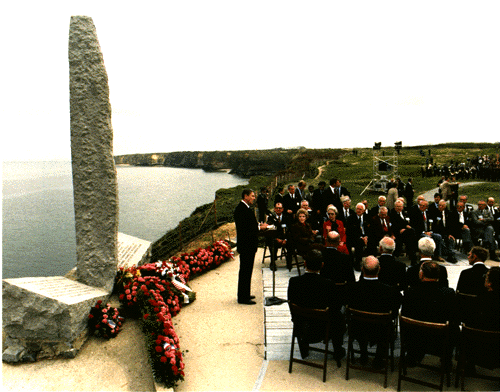
Brinkley’s book also showcases what took place on the 40th anniversary of D-Day when President Reagan went to the Normandy coast and delivered speeches that should be recognized as some of the most inspirational in American history. One took place at the top of those cliffs in front of the memorial set up to honor those Rangers.

In the audience that day in 1984 were surviving Rangers who returned to remember and commemorate those who lost their lives in that daring mission. Reagan’s speech was important, as it made clear to a new generation what a previous generation sacrificed for liberty.

It was so fitting that twenty years later, on June 5, 2004, Ronald Reagan passed from this side of life into eternity. Just as all the media converged on Normandy again for the 60th anniversary, they also had to cover Reagan’s death. His tributes to his own generation were replayed that weekend over and over, so that another rising generation would learn a valuable lesson—if they would take heed.

Then there’s today, June 7. For that one, let’s go back 235 years to 1776. It was on this date that Richard Henry Lee of Virginia, with the full endorsement of his state, brought to the Continental Congress a series of resolutions, beginning with a bold statement that all allegiance to Great Britain should be dissolved and that a new United States of America should be established.

Another of his resolutions was that a committee should be formed to draw up a draft of a declaration of independence—just in case it might be needed. That committee was composed of five gentlemen, three of whom are most often mentioned: Thomas Jefferson, John Adams, and Benjamin Franklin. This was the beginning of the end for colonial America and the start of something brand new, a nation declaring independence because the God of Nature had bestowed on all people the unalienable rights of life, liberty, and the pursuit of happiness, among others.

Let’s celebrate our heritage, whether it be from 1776, 1944, 1984, or 2004. Let’s remember our beginnings, as well as the times when we’ve demonstrated most openly the spiritual and moral underpinnings that formed the cornerstone of that heritage.

Disrespect?

I know a lot of American citizens were disturbed by President Obama’s absence on Memorial Day from the ceremony at the Tomb of the Unknown in Arlington Cemetery. I’ve been there on a number of occasions, and it is meaningful to observe the changing of the guard.

While I understand the dismay expressed by many, there are two reasons why I didn’t share it fully. First, Obama was going to another cemetery in Illinois, so he was marking the occasion; second, and perhaps more cynically, I felt it might be better if he weren’t there. In my opinion, he has little respect for America or the military, so I thought the ceremony might be better without him. I realize the symbolic importance of the president at least showing outward respect, but what’s in the heart is far more important—and the heart is revealed through actions.

However, when Sunday, June 6, passed, and the White House didn’t even acknowledge the significance of that day, I must admit that was an inexcusable omission. Ronald Reagan, for instance, never let the D-Day anniversary pass without highlighting it. His 1984 speeches in Normandy were a key event in his administration as they put the spotlight on the sacrifices of the men who began on that day to take Europe back from Hitler.

Personally, I look upon this snub by the White House as the height of disrespect for those who died to set other people free and to ensure the United States would never succumb to the Nazi evil.

Some commentators have taken the step of referring to Obama as the first post-American president. Sad to say, I believe there is evidence for that.