
Sin, Repentance, & Judgment: A Neglected Message

A week ago, I wrote a post I called “The Moral Majority?” In it, I outlined two misperceptions I believe are hampering efforts to turn around the culture. The first misperception is that too many of us think we still live in a majority Judeo-Christian society. We think we’ll just eventually come to our senses and everything will be alright. The second misperception is that we can live a Christian life without holiness. We blend too easily into our culture and don’t want to embrace God’s righteous standards. I’d like to follow up on those thoughts.

One of the key reasons, in my view, that we don’t live righteously is the message that the church too often proclaims—a message that doesn’t really require a change of heart and action on our part. We are told continually that God’s love is unconditional, and that He will accept us just as we are. There certainly is truth in those statements, but the implications we attach to them undercut what I would consider real salvation.

Yes, God’s love is unconditional. He loves us in spite of what we have done and what we are. But that’s not the same as saying salvation is unconditional. There are very specific conditions before we can enter into a relationship with the One who unconditionally loves us. First, we need to grasp the nature of sin, the utter selfishness behind it, and how it destroys all that God intends for His creation. Only when we come to grips with the evil that not only infests the world, but permeates us as well, can we take the next step, which is a deep and genuine repentance over the sin that we have allowed to control our lives.

Far too many evangelists, pastors, and para-church organizations skip these steps. They are eager to make converts, so eager at times that they just want people to come forward to the altar without first leading them into an understanding of their sin and the need for repentance. Without these two vital components, though, there can be no salvation. Why? Because the basic problem that separates man from God has not been addressed.

We tell these potential converts that all they have to do is accept what Jesus did for them, and then we assure them they are saved. Those whose hearts were prepared for the message are genuine converts, but I believe the majority have simply given an intellectual assent to the need for a savior and want to have what has sometimes been called “fire insurance.” I mean, who wants to go to hell?

The problem is then compounded when we declare that they can never expect to live up to God’s standards since His demands are too onerous for any of us to achieve. We solemnly assert they will probably keep on sinning as they have done before, but not to worry because they’re going to heaven anyway. We lower the expectations to where they’re already met.

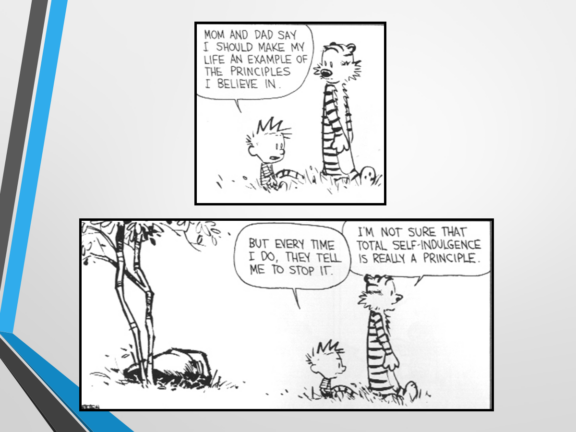
This theology has its manifestation in a bumper sticker I used to see on cars that stated categorically, “Christians aren’t perfect; they’re just forgiven.” It’s almost like saying, “Hey, I’m just as bad as you, but I get to go to heaven.” What a great salvation—I can continue to sin as much as I used to, but I don’t have to bear the consequences.

No, that’s not salvation. And the reason we are a weak church, and the reason we are fuzzy over moral issues like homosexuality, can be traced to the prevalence of this diluted theology.

I am prepared to be called judgmental because of these comments. That’s fine. God has called us to be righteous judges, as long as we cleanse ourselves of hypocrisy and we offer our judgments along with the message of reconciliation. The glorious thing is that God says we can be set free from the power of sin in our lives, but we must begin with a proper recognition of the pernicious nature of that sin and earnestly desire a changed heart. That’s when the atonement of Jesus can flood our hearts with His love, all our past sins can be forgiven, and we can walk in newness of life. The only reason I’m “judgmental” is because I want people to experience victory in their daily lives.

Avenger Obama Going “Forward”

I wrote a post a few days ago about the Obama campaign’s new slogan, “Forward.” It’s so ripe for parody, it’s almost too easy to do. Examples abound, many with the same theme:

What were they thinking by promoting this slogan? The cartoonist Michael Ramirez may have figured it out:

Obamacare is nowhere to be found in any current Obama ads. Wonder why? What does he have that he can tout? Well, one thing:

Maybe you can get the T-shirt:

I realize some have criticized the president for overplaying his hand in this matter. Well, to be honest, I have criticized the president for putting himself front and center and seemingly taking all credit. Perception is the key in campaigns. Perhaps we’ll be seeing this soon:

Try not to get too ill before election day.

Poster Child for the Zombie Nation

If you haven’t seen “The Life of Julia,” you need to Google it. She’s a fictional character created by the Obama campaign to demonstrate how government helps people. If you watch the entire thing, though, you come away with the distinct impression that people—perhaps women, in particular—are utterly helpless without government aid. This campaign ploy is the best/worst advertisement for  the cradle-to-grave nanny state that I’ve seen in some time. “Julia” only succeeds because of government. There is no mention of a family helping her, a husband along the way, certainly nothing spiritual in her supposed “life.” She is the poster child for the zombie nation.

The really scary part about it is how this reveals the worldview/mindset of those in authority in our civil government. “Keep us in power,” they seem to be saying, “and we’ll make you a functioning person, made in our image.” And of course all it takes is more money to accomplish all this. Never mind that programs mentioned in “The Life of Julia,” such as Head Start, don’t actually give anyone a genuine head start. We’re supposed to ignore the data on that and just trust the government knows what it is doing.

Well, we haven’t seen too many examples of that recently, have we? There was the spectacle of the GSA employees, which was undoubtedly only the very tip of the very top of the iceberg of waste.What’s even more disturbing, however, is the false perception that persists among an ever-increasing proportion of our population:

It’s not too late to reverse this whole “government is your big daddy” mindset, but we have to work quickly. Let’s start this November.

Obama, Illegal Immigration, & the Court

The Obama administration has had quite an innovative approach to the problem of illegal immigration. Whenever a state decides to enforce the federal laws that already exist, such as in Arizona where the law they passed was merely a reaffirmation of what the federal government should be doing, they get a rather strange reaction from Washington:

The Obama Justice Department is so outraged by states trying to help that it has taken this all the way to the Supreme Court. Arguments were held last week, and if you haven’t heard much about it, it might be because it didn’t go too well for the administration. The same lawyer who tried to defend Obamacare was back, once again attempting to defend the indefensible. His case was so weak, reports indicate even some of the liberal justices may have to jump the ideological ship on this one:

So now we have insight into the administration’s strategy—make sure the economy stays so bad that no one in their right minds would ever want to cross the border illegally:

The president himself is so perturbed with the Court that he’s been trying to pressure it to see things his way, but he’s meeting with some resistance:

Take a moment today and thank God for the checks and balances set up in the Constitution. Sometimes they actually can work.

Proverbs 9:7-10

He who corrects a scoffer gets dishonor for himself, and he who reproves a wicked man gets insults for himself. Do not reprove a scoffer, or he will hate you; reprove a wise man and he will love you.

Give instruction to a wise man and he will be still wiser; teach a righteous man and he will increase his learning.

The fear of the Lord is the beginning of wisdom, and the knowledge of the Holy One is understanding.

Going “Forward”

The campaigns are well underway now; no one is holding back. The Obama team apparently has come up with the new buzzword. In 2008, of course, it was “Hope and Change.” That obviously won’t work this time around because people would be thinking, “yeah, we do need a change—that might be our only hope.”

So now Democrat legions are to be inspired by the one simple word “Forward,” which is supposed to be a positive message. However, it seems to have gone awry already:

Obama has never broken his bad habit of blaming everything on Bush. Don’t expect that to stop. He’ll have plenty of help, too, from an obliging press corps:

Voters, though, may have a different response when they realize his idea of progress comes at their expense:

Another embarrassing fact that has come to light is that “forward” has historically been a favorite slogan for communist/socialist movements. Did the Obama people know this ahead of time? I find it hard to believe they were unaware of its history. Apparently the association doesn’t bother them all that much. If, though, we see a sharp turn away from the new slogan in the coming days, we will know they have decided it won’t work.

On the Republican side, with the suspension of the Santorum and Gingrich campaigns, Romney is the nominee-in-waiting. While he hasn’t enjoyed the enthusiastic backing of many conservatives, he is the only alternative to another Obama term, so most Republicans have resigned themselves to the inevitable:

The political world is now speculating who will take second place on the ticket. It’s an important decision for Romney, particularly if he wants conservatives to rally to him. Hopefully, more serious thought will go into that choice than was demonstrated four years ago on the Democrat side:

I keep coming back to how the future of the country truly does rest on the outcome this November. This might be the most significant election thus far in my lifetime.

The Moral Majority?

My main reason for writing this blog—its only real purpose—is to bring the Christian message to the forefront as we contemplate the state of our culture and the society in general. Within me resides a hope, which I trust comes from the Giver of All Hope, that what I write can aid, in whatever small way, in restoring a Biblical pattern of thinking that will, in turn, strengthen the foundations upon which our society is built.

I believe there are two chief impediments that are making it difficult to make progress. The first is a misperception that guides some of us hoping for societal restoration; the second is a profound personal failing on the part of those who claim the name of Christ.

What is that misperception? We seem to think that there is a silent majority out there just waiting for the re-emergence of Christian culture. What we fail to understand is that we are living in a post-Christian nation. Whereas, in decades past, most Americans would have subscribed to some type of Christian morality, we are now a nation bitterly divided over the nature of morality—or indeed whether such a thing as morality even exists. Jerry Falwell, as he attempted to get Christians involved in politics back in the early 1980s, started an organization he called The Moral Majority. It rested on the assumption that most Americans believed in Biblical morality.

That was the case at the Founding of the nation; even those who cannot be classified as Christian believers lived in a culture that expected people to adhere to the basic moral teachings of the Scriptures. The onset of evolutionary theory severely undercut that consensus, which eventually led to the holocaust of abortion, the drive for same-sex marriage, and a general philosophy of postmodernism, where each person constructs his own concept of morality. Polls seem to indicate that nearly two-thirds of Americans rarely gather in a church on Sundays.

Yet we continue to act as if what we promote is generally accepted by the society at large. No, it is not. Promotion of the homosexual lifestyle shows up in nearly every television program, in one way or another. It is just assumed by the media that couples live together and engage in sex routinely before marriage. Unfortunately, there’s plenty of evidence to bolster their assumption.

The myth of the moral majority must be shattered before we can make any real progress. We have to see reality for what it is first so we’ll know how to proceed.

The second problem, though, is deeper, and it’s the primary reason we don’t have the kind of influence we seek. It has to do with personal holiness. Now, I know that word—holiness—has become a turn-off. It reeks of past attempts to focus entirely on externalities: don’t wear makeup, don’t watch television, etc. Christians have been their own worst enemy by making holiness into a repellent idea.

True holiness, though, is beautiful. It simply means one’s love for God inspires our thoughts and actions. Holiness is an attitude of the heart that seeks to please God in all we do, and it’s a joyful thing. Yes, a heart for God will lead to changing our external actions, but not because we follow a list of rules. We change because we want our lives to honor the One who brought us out of darkness into His light; we change because it connects us to His heart; we change because it brings harmony and His love into the lives of others with whom we associate.

Christians who live holy lives are attractive; they draw others to them, thereby providing an opportunity to deliver the message God has placed on their hearts: personal salvation first; societal salvation as a result of the permeation of Biblical principles into the society.

My concern is this: too many people who claim the name of Christ don’t portray the Christ they claim to know. I’ve been a Christian now for many decades. I’ve seen true holiness in action; it does exist. Yet it is not the norm. I’ve taught at four Christian institutions of higher learning and have witnessed the sad spectacle of sin destroying that which is good. We don’t talk much about sin anymore; it’s an embarrassment to mention the word in our culture. If we mention it, we’re accused of being judgmental.

But I want to say something very direct: sin is killing us. I am saddened almost daily by “Christians” who don’t act much differently than the world around them, whose language is filled with the same crudeness that we say we deplore, whose attitudes show forth in gossip, slander, and revenge. Those who name the name of Christ have no problem with “shacking up,” accepting homosexuality, or allowing the government to become God. They are endorsing the very sins that are sending our nation into spiritual darkness. Is it any wonder we hardly make a dent in the culture?

I am grateful for those who stand for righteousness; they do make a difference. But far too many who say they want to make a difference are not different themselves. That will never work. What we need is this reminder from Scripture:

Therefore be imitators of God, as beloved children; and walk in love, just as Christ also loved you and gave Himself up for us. …

But immorality or any impurity or greed must not even be named among you, as is proper among saints; and there must be no filthiness and silly talk, or coarse jesting, which are not fitting, but rather giving of thanks. For this you know with certainty, that no immoral or impure person or covetous man, who is an idolater, has an inheritance in the kingdom of Christ and God.

Let no one deceive you with empty words, for because of these things the wrath of God comes upon the sons of disobedience. Therefore do not be partakers with them; for you were formerly darkness, but now you are Light in the Lord; walk as children of Light (for the fruit of the Light consists in all goodness and righteousness and truth), trying to learn what is pleasing to the Lord. Do not participate in the unfruitful deeds of darkness, but instead even expose them.

Those are not my words. They come from Another. My job today is simply to deliver them. Your responsibility, if you say you are a Christian, is to ponder them and act upon them.