
One of the reasons I enjoy teaching about C.S. Lewis and sharing his thoughts is that he is so good at putting deep thoughts into words that should communicate well with almost any audience. One doesn’t have to be an academic to figure out what he is saying. In one of his essays, “Christian Apologetics,” he offers this guidance:
He continues in that same essay with sound advice for anyone seeking to present Christian truth: “You must translate every bit of your Theology into the vernacular.” Professional theologians sometimes have difficulty doing that. They use terms that are certainly appropriate to their field, but might not realize that they can talk “over the heads” of some of their hearers. Speaking instead at the level of an audience not accustomed to one’s own field of work not only helps the audience, but Lewis also notes that it is helpful to the speaker as well.
I have come to the conviction that if you cannot translate your thoughts into uneducated language, then your thoughts were confused. Power to translate is the test of having really understood one’s own meaning.
Lewis put his own advice into practice when he spoke on the BBC during WWII and then later put those radio talks into book form in Mere Christianity, a classic that I’m currently teaching at my church. For instance, the very first paragraph of the very first chapter begins in this way:

That wouldn’t have been the usual way for an Oxford Don to introduce a deep theological issue, but Lewis knew he needed to get his audience’s attention. So he offered what could have been a typical type of back-and-forth that people engage in daily. His topic, as the first section of the book declares, was “Right and Wrong as a Clue to the Meaning of the Universe,” a weighty topic indeed, yet one essential for understanding one of the cornerstones of reality, a reality that points to the truth of Christian faith.
The chapter title for this section was “The Law of Human Nature,” which, again, could be tough intellectual meat to chew. Lewis, though, leads the reader step-by-step from an argument about what is right or wrong in a personal interaction into a broader treatment of right and wrong embedded in the universe. He shows how every culture in human history has accepted this concept of right and wrong, and that they mostly have an agreement on what is right and what can be considered as wrong. Now, some may claim not to believe in a real right and wrong, but Lewis is quick to point out the inherent hypocrisy of that position.
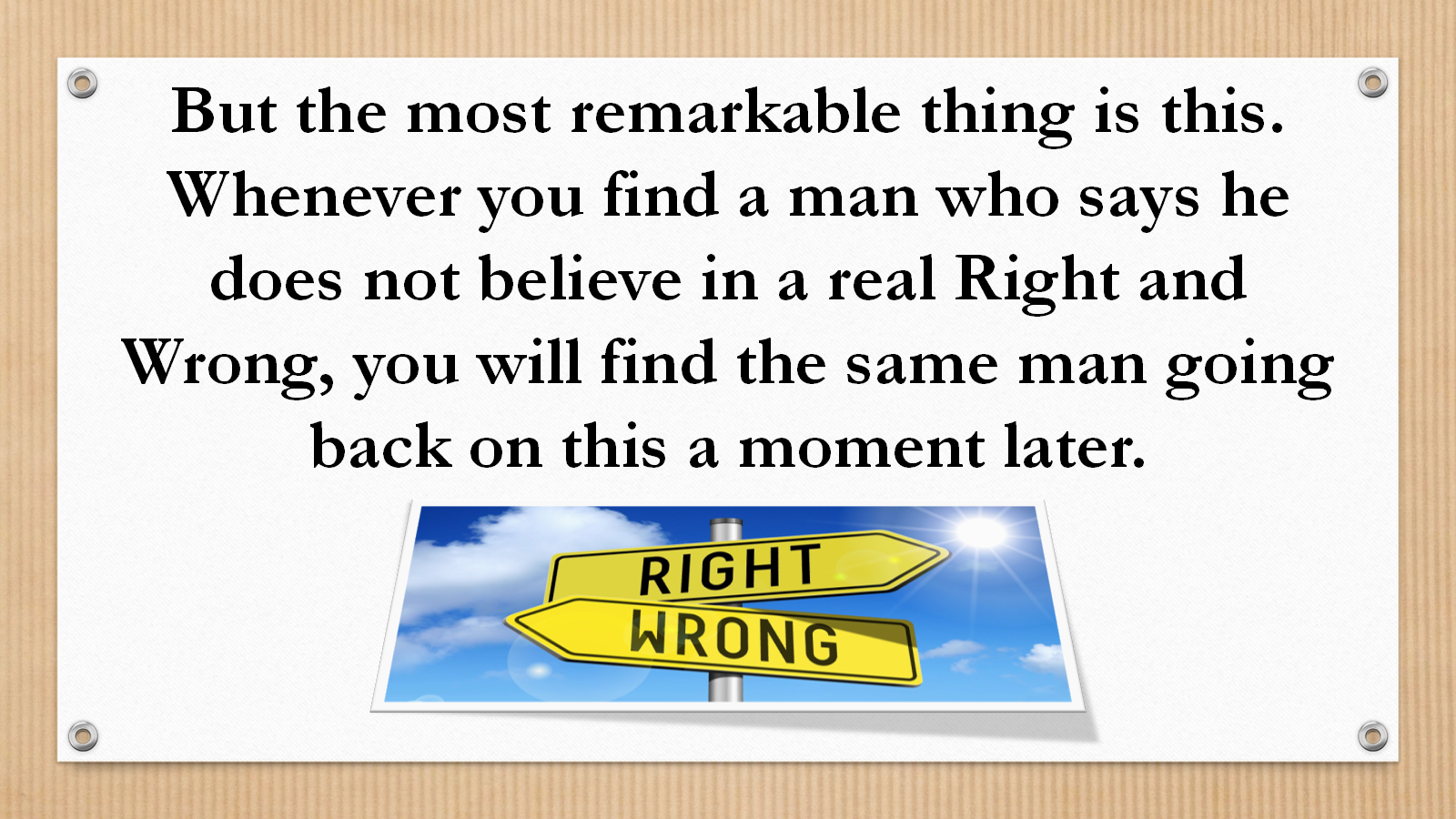
Lewis confesses that he doesn’t keep this Law of Nature as consistently as he should “and the moment anyone tells me I am not keeping it, there starts up in my mind a string of excuses as long as your arm.” They may not be good excuses, but that’s not the point. Just the fact that we come up with all those excuses is evidence that we do really believe in a law of nature.
This is the approach Lewis uses throughout Mere Christianity, and it serves as a lesson for the rest of us who want to ensure that when we speak of the Christian faith, we do so in language that can be easily understood. After all, the goal is not to impress anyone with our exalted wording; rather, we want others to grasp what God’s truth contains and what it means for their own lives.